The Well-Priced Booth
5 ways to avoid losing money on antique booth inventory that doesn’t sell
For antique mall vendors with a full booth and pieces that have sat since spring. If your booth has empty shelves, or you sell online only, this isn’t for you — the whole problem here is that space is finite and rented.

The part nobody tells you about running an antique booth
You can get almost everything right and still lose money on a piece.
You found it cheap. You cleaned it up. You tagged it, you staged it, you refluffed the shelf around it twice. And it has sat there since April, doing nothing, while you paid for the floor underneath it every single day.
That last part is the bit that goes missing. Many malls price booths by the square foot, by the month — that’s the deal you signed. ResaleOS, writing about booth break-even math in August 2026, puts typical booth rent at $100 to $600 a month, with the mall commonly taking 10% to 15% commission on top. So the shelf is metered. Every piece on it is running up a bill whether or not anyone touches it.
Almost nothing in the category prices for that. The advice you’ll find is about what a piece is worth — comps, markup multiples, what it “should” go for. All of that answers what is this. None of it answers what is this costing me to keep.
So when a piece sits, you didn’t do anything wrong. You used the method you were given. The method just doesn’t have a term in it for the thing you’re actually paying.
There’s a decent sign that this is a real gap and not just our opinion. The biggest booth vendor group on Facebook, with more than 70,000 members, has a rule against pricing discussions. Its admins started a separate group in October 2025 for pricing help alone; when we checked it on 17 September 2026 it had 21,065 members, at 48 weeks old. Tens of thousands of vendors went looking for somewhere to ask this question. That’s not a crowd with good answers.
We read and coded 35 booth vendor posts and comments — group highlight posts, blog comment sections, seller comments on YouTube. Pieces that sit was the most common problem in them, in 10 of the 35. It’s a small, directional sample and we’d rather say so than dress it up. But it matched what we expected to find, which is that everyone is stuck on the same thing and nobody’s method accounts for it.
The Well-Priced Booth
Complete Pricing System
$27.00
One payment. Instant download. 7-day money-back guarantee.
What actually separates a method that works from one that doesn’t
Before the list, here’s the standard we ranked against: six things a pricing method has to do when the booth is already full and the piece is already sitting. Each method below is measured against them, and the downside named for each one is a point it misses.
- 1
It has to work on the piece that’s already stuck
Most pricing advice is buying advice wearing a disguise — it tells you what to pay next time. That’s useful in three months. It does nothing about the dresser sitting in your booth right now, and the dresser is why you’re reading this.
- 2
It has to know what the piece costs you to keep
Space is rented by the square foot and by the month, so a teacup set and a dresser are not the same problem even when they’ve sat the same number of days. A method that treats them the same is ignoring the only bill you’re definitely paying.
- 3
It has to end in a decision, not a number
“This is worth $80” leaves you exactly where you started. Cut it, move it, bundle it, pull it — a method that doesn’t produce one of those hasn’t finished the job.
- 4
It has to work in your mall, not the national market
Sold comps tell you what something went for somewhere. Your piece is only in one market: the building it’s standing in, in front of the people who walk through it. Those are often not the same number.
- 5
You have to be able to finish it
Anything you’re supposed to keep up with daily is something you’ll abandon in week three, and then feel bad about. The thing that survives contact with a real month is a decision that closes.
- 6
It can’t depend on shoppers doing something
You control cutting a price, moving a piece, bundling it, pulling it. You don’t control who walks in on a Saturday. Any method whose outcome is “and then it sells” is promising you something it can’t deliver.
The five methods, ranked worst to best
Restyle the booth and fluff it more often

What it is: re-stage the shelves, improve the lighting, group things into vignettes, get in once or twice a week to tidy and reset.
Who it’s actually for: vendors whose booth genuinely is a mess, or who are new and haven’t found a look yet. It works. A well-merchandised booth does better than a crammed one, and this is the cheapest advice in the category because it’s mostly free.
The honest downside: it fails criterion 3 and criterion 6. Restyling doesn’t decide anything — it improves the odds and hands the outcome to the shopper. And it’s the most common thing a stuck vendor does instead of making a call, because it feels productive. You can fluff a dresser every week for four months. It’s still a dresser nobody bought, and now it’s four months of rent.
Price from sold comps

What it is: look up what the piece actually sold for on eBay or WorthPoint, price from that.
Who it’s actually for: anyone holding something they genuinely can’t identify or value. For a marked piece, a signed piece, anything collectible, this is the right first move and we’d do it too.
The honest downside: it fails criterion 4 hardest. A sold comp is a price from a national market of people who searched for that exact thing. Your booth is a building in one town, and the person walking past isn’t searching — they’re browsing. Vendors say this in their own words as the gap between book value and decorative value. Comps also fail criterion 2 completely: eBay doesn’t know your piece takes up eight square feet of rented floor.
A markup multiple
What it is: price at a fixed multiple of what you paid. The booth educators we’ve read teach 3x, or 4x to 7x — Lost & Found Decor says charge at least 3x cost; Vintage Booth Pro teaches 4x to 7x depending on the mall’s commission.
Who it’s actually for: somebody who needs a tag on a piece in ten seconds and has nothing else to go on. As a default it’s much better than guessing, and both sources are giving it away free.
The honest downside: it breaks on exactly the pieces you’re worried about. A multiple counts what a piece cost you and nothing else — not the square feet it occupies, not the days it’ll sit. In the example booth we use throughout our own material — $240 a month for 80 square feet, a 13% mall cut — a $40 dresser tagged at 3x is $120. If it sits four months, it comes out at a $31.60 loss once the mall’s cut and the rent on its space are counted. The multiple said $120 was right. The arithmetic says you’d have been better off not buying it. Also note the two sources contradict each other, 3x against 4x–7x, which tells you the number was never derived from anything.
Mark everything down at 60 to 90 days
What it is: the standard stuck-inventory rule. Anything unsold after 60 to 90 days gets 20–30% off, or moves. Vintage Booth Pro teaches this one in its free pricing post, and it’s the closest thing the category has to a system.
Who it’s actually for: anyone doing nothing at all. A dated rule beats no rule, by a lot. If you take only one thing from this page and it’s “put a date on it,” you’re ahead.
The honest downside: it’s the right idea aimed at the wrong variable. The clock runs on the tag’s age, so every piece gets the same date regardless of what it’s costing you. A teacup set on a shelf takes about half a square foot. A dresser takes about eight. Under the size classes we use, that makes the dresser sixteen times the small piece in space — so by the same 90-day date, the dresser has run up sixteen times the rent, and gets the same 20% off.
Which means the rule sends your markdowns to the pieces with the oldest tags instead of the pieces eating the most floor. You end up discounting teacup sets that cost pennies a day to keep, while the dresser waits politely for its turn.
That’s not a small correction. It’s the whole thing.
Price every piece against what its space costs
This innovative approach is called the Rent Share method. It works because it’s the only approach we’ve found that treats your inventory as needing to “pay rent” for the space and time it occupies in your booth.
The mechanism. You turn your rent into a cost per square foot per day. In the example booth — $240 a month, 8 by 10 feet, a 13% mall cut — that comes out at 10¢ per square foot per day. Now every piece has a meter on it: the teacup set costs a nickel a day to keep, the dresser costs 80¢. Same shelf, same date, sixteen times the bill.
From there, three things follow.
Every tag gets a sell-by date, set by the piece’s size and by how fast that kind of piece sells in your mall — not a flat 90 days for everything. Big and slow gets a short leash, because it’s expensive to house. Small and quick gets a long one, because it’s nearly free to keep.
At a monthly sweep, every piece past its date gets compared one way: is the markdown it needs smaller than the rent its space will cost over the next 30 days? If yes, cut it — you’re buying back more than you’re giving up. If no, it moves, bundles or leaves. That’s criterion 3 satisfied: you end the sweep with a call on every piece, not a list of valuations.
And when you’re out buying, the same arithmetic runs backwards into a cap — the most you can pay for a piece of that size and speed and still come out ahead. Criterion 1 is the sitting piece in front of you; this is the one you’re about to make.
Why it satisfies what the others missed. It works on pieces already in the booth (1). It’s built entirely out of what space costs (2). Every sweep produces cut, move, bundle or pull (3). The speed classes come from your own mall’s sales report, not a national market (4). It’s one pass a month, not a daily habit (5). And every outcome is something you do, not something a shopper does (6).
How to implement the #1 Rent Share method in only 30 days
We’ve put together an easy to understand guide and collection of printable tools that takes the guesswork and tedious calculations out of pricing antique booth items the smart way.
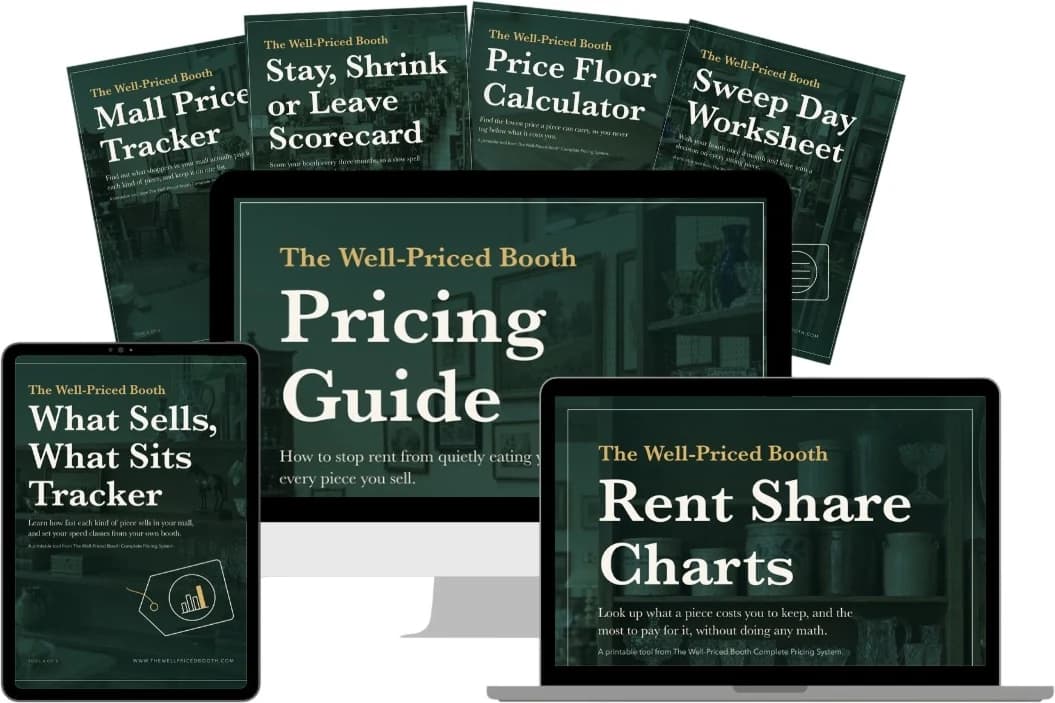
What’s actually in it. A 47-page guide, written for first-time vendors and people who’ve had a booth for years, with a setup worksheet, a first-30-days plan, a booth map, a tag-date checklist, a sitting piece decision chart and a page showing the exact arithmetic printed right inside it. And six printable tools, each as its own PDF:
- Rent Share Charts and Max-Pay Charts — ready-made tables for rent levels from $1 to $5 per square foot per month, so you look a number up instead of working it out
- Price Floor Calculator — the lowest price a piece can carry, so you never tag below what it costs you
- Sweep Day Worksheet — walk the booth once a month and leave with a decision on every sitting piece
- What Sells, What Sits Tracker — how fast each kind of piece sells in your own booth, which is what sets its speed class
- Mall Price Tracker — what shoppers in your mall actually pay for each kind of piece, kept on one list
- Stay, Shrink or Leave Scorecard — score the booth every three months, so a slow spell doesn’t become a gut decision
What it promises, exactly. Within 30 days, you’ll know what every piece in your booth is costing you to keep, and exactly what to do about each one past its sell-by date: cut the price, move it, bundle it with something else, or pull it.
And it runs on your numbers, not ours. Your rent, your square footage, your mall’s commission, and speed classes that come out of your own sales report — with a rule for changing them when your booth says the first guess was wrong. The example booth throughout is there to show the arithmetic working. Yours is the one it runs on.
The Well-Priced Booth
Complete Pricing System
$27.00
One payment. Instant download. 7-day money-back guarantee.
If this month goes the way last month did
The dresser is still there in October. It’ll have cost you another month of floor, and you’ll make the same decision then with less money and less patience than you have now.
The criteria haven’t changed: it has to work on what’s already stuck, it has to know what the piece costs to keep, and it has to end in a decision you can make without a shopper’s help. Whatever you pick, pick something that does those three.
Learn moreFree Offer
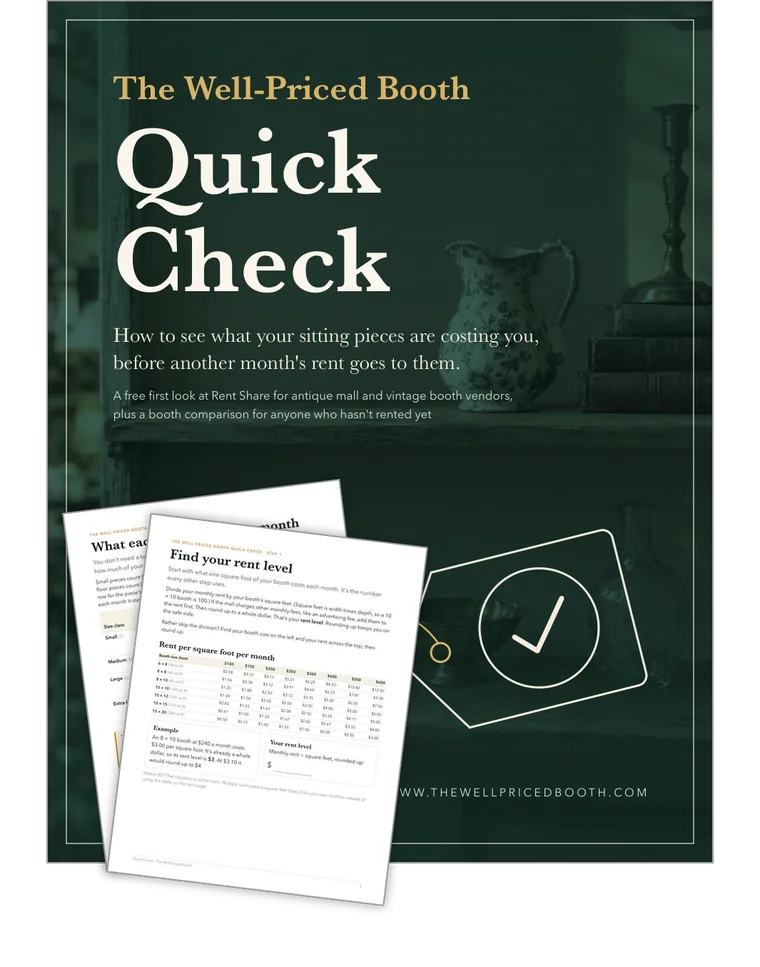
Not ready for the whole method? Try it on five pieces first.
Our 10-page Quick Check guide helps you decide what to do with your 5 longest-sitting pieces and includes a bonus worksheet for comparing antique mall booth opportunities.
Sources and disclosure
- ResaleOS, “Antique Booth Break-Even: Why 3x Rent Usually Isn’t Enough”, 3 August 2026 — rent range, commission range, and the 3x / 5–6x rule of thumb.
- Lost & Found Decor, “How to Pick the Right Price for Your Antique Booth Items” — the 3x markup.
- Vintage Booth Pro, “How to Price Vintage Items for Your Antique Booth” — the 4x–7x markup and the 20–30%-after-60–90-days markdown rule.
- Facebook group about pages for “Booth Vendor & Antique Store Talk & Support” and “Booth Vendors & Antique Store Selling & Pricing Help”, read 17 September 2026.
- Our own coded sample of 35 booth vendor posts and comments.
Citing these is not an endorsement by any of them, and none of them has any connection to us or to what we sell. We disagree with some of the advice above and we’ve said where.
Disclosure: We built the method ranked at number one and we sell it. The four above it are real alternatives described as fairly as we know how, and two of them are free.